Support automation starts with a choice of format: a scripted chatbot or an AI bot. The terms sound alike, so companies often take a complex solution where a few menu steps would have been enough, or try to close non-standard requests with buttons.
Below is how each format works, what separates them and which signs to look at when choosing a solution for your own tasks.
The difference in short
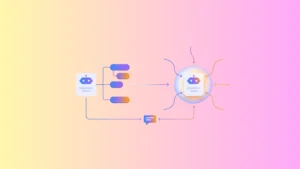
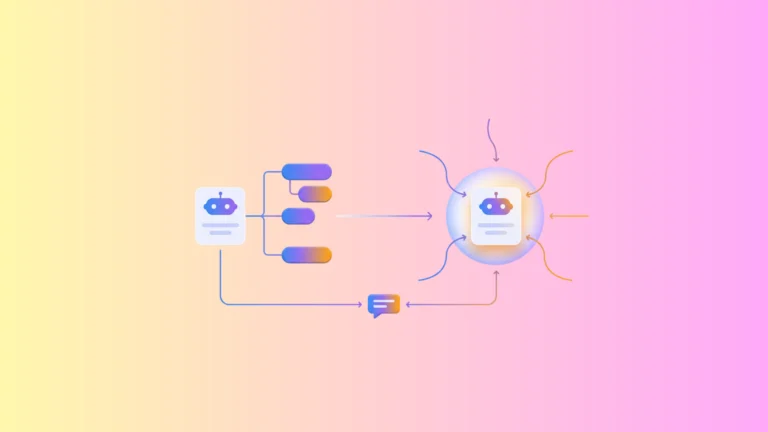
A scripted chatbot leads the customer along a route defined in advance: buttons, menus, sequential steps. An AI bot recognises free-form wording and builds an answer from the company knowledge base. The first format gives predictability and a launch within a day, the second gives flexibility on complex requests. Most companies end up combining both.
What a scripted chatbot is
A scripted, or button-based, bot follows a scenario written in advance. The customer taps a button or sends a keyword, and the bot moves to the next step. Every reply is written beforehand, so the bot behaves predictably from the first message to the last.
Such a bot covers more than reference questions. Through integrations it pulls data from internal systems: order status, account balance, the nearest branch, available booking slots.
Strengths
- control over every reply and over the tone of communication;
- launch within a day without developers;
- stable performance on typical high-volume requests;
- clear analytics: you can see the step where customers leave the dialogue.
Limits of the format
- works within the topics written into the scenario: anything outside it goes to an agent;
- each new topic needs its own branch, so the scenario grows gradually;
- every language needs its own version of the scenario.
What an AI bot is
An AI bot is built on language models. It recognises the customer intent regardless of wording, typos or informal style, and builds the answer from company materials: instructions, knowledge base articles, internal rules, dialogue history.
A customer writes “ordered two pairs yesterday, one did not fit, what now” and receives an explanation of the exchange terms instead of a list of buttons. The bot holds the context of the conversation and handles follow-up questions inside a single dialogue.
Strengths
- answers free-form requests, including those absent from any scenario;
- one logic serves several languages;
- new topics are added by updating the knowledge base;
- takes consultation load off agents, not only reference questions.
Points to consider
- answer quality depends on how current the knowledge base is;
- topic boundaries and handover rules are required;
- replies need spot checks, especially during the first weeks;
- transactional actions still require integrations and strict logic.
Comparison of the two formats
| Criterion | Scripted chatbot | AI bot |
| Operating principle | Ready-made scenario with buttons and keywords | Intent recognition and answer generation |
| Source of answers | Texts written in advance | Company knowledge base and dialogue context |
| Unusual wording | Returns to the menu | Understands the request and answers on merit |
| Launch time | One day | From several days, depending on the knowledge base |
| Who sets it up | The company team in the interface | The implementation team on the provider side |
| Multilingual support | A separate scenario per language | One logic for several languages |
| Transactional actions | A strength of the format | Requires integrations and clear rules |
When a scripted bot is enough
The button format fully covers the task if your support recognises itself in these signs:
- five to ten topics make up most of the requests;
- customers send the same questions: order status, opening hours, pricing;
- you need appointment booking, request forms or routing to a department;
- full predictability of answers matters, for example in finance or healthcare.
When a business needs an AI bot
Moving to the AI format pays off when the scenario stops coping:
- customers phrase questions differently and the menu covers only part of the requests;
- the company has a complex product or a wide range with dozens of details;
- there is an accumulated knowledge base: instructions, help articles, internal rules, ready answers;
- the share of dialogues handed over to agents stays high despite scenario improvements.
Which format fits which task
| Task | Format | Reasoning |
| Order status, tracking number | Scripted | Needs an integration and an exact answer |
| Opening hours, addresses, pricing | Scripted | A limited set of facts that rarely change |
| Appointment booking, request forms | Scripted | Step-by-step data collection with field validation |
| Free-form product questions | AI bot | Wording is unpredictable, the answer is in the knowledge base |
| Support in several languages | AI bot | One logic instead of a scenario per language |
| Non-standard complaints and disputes | Hybrid | AI recognises the topic, then the dialogue goes to an agent |
The hybrid setup in practice
The customer opens the chat and sees a greeting with a short menu – that is the scripted part. They tap “Order status” and the bot follows strict logic: asks for the number, queries the system, returns exact data. They type a question in their own words and the AI part answers from the knowledge base. The topic goes beyond the allowed scope or the customer asks for a person – the dialogue moves to an agent together with the message history.
It is easier to start simple. First a scenario for the most frequent requests, then statistics on unrecognised queries, and the knowledge base for the AI part is built on that data.
What to plan before launch
- Collect the top 30 requests from the last three months and mark which are typical and which are not.
- Describe the escalation rules: which words, topics or number of failed attempts send the dialogue to a person.
- Keep the handover button available at every step.
- Keep the menu shallow: six taps to an answer and the customer moves to another channel.
- Split long messages into parts with pauses so they can be read.
- Set separate logic for out-of-hours: nights, weekends and public holidays.
- Review dialogues monthly, otherwise the bot ages along with your terms and product range.
How to measure the result
A minimum set of metrics worth reviewing every month:
- automation rate – the share of dialogues closed without an agent;
- the reasons for handovers, not only their number;
- unrecognised requests – the main source of improvement ideas;
- first response time, separately for working and non-working hours;
- customer rating of the dialogue and conversion into the target action: a request, a booking, an order.
Two levels of automation in NovaTalks
The omnichannel platform NovaTalks offers both formats as two levels of automation that a company can move between without migrating to another platform.
Basic chatbot: the free level
- up to 10 scenario and logic points, a ready-made template for a quick start;
- self-setup in the interface, launch within one day without developers;
- work in a chosen channel: website live chat or messengers;
- handover to an agent at any moment, including out-of-hours.
AI bot for business
- recognises customer requests phrased in their own words, including mixed language;
- learns from your company knowledge base;
- holds a full dialogue and resolves complex requests on its own;
- works in any text channel, implemented by the NovaTalks team.
This split removes the risk of choosing at the start: a company builds a free scenario, looks at real requests and only then decides whether the AI level is needed. Settings, channels and request history stay in place during the move.
Frequently asked questions
What is the difference between an AI bot and a chatbot in simple terms?
A chatbot follows a scenario written by the team: buttons, menus, answers prepared in advance. An AI bot understands a free-form request and builds the answer from the company knowledge base.
Does an AI bot replace a scripted one?
In most cases it does not. Transactional tasks – checking a status, booking, submitting a request – work more reliably on strict logic. AI covers consultation requests that cannot be predicted in advance.
Where is it better to start if there is no bot yet?
With a scenario for the most frequent requests. In NovaTalks the basic level is free, so the hypothesis can be tested without a budget: up to 10 logic points cover most typical questions and provide statistics on real requests.
Do you need a developer to create a chatbot?
Not for the basic chatbot – it is set up in the interface and can be edited at any moment. The AI bot is implemented by the NovaTalks team based on the company knowledge base.
What should happen when the bot does not understand the customer?
Provide a proper exit: a short explanation, alternative options and an available button to reach an agent. All unrecognised requests are worth exporting and analysing.
How does the bot work out of hours?
For nights, weekends and holidays a separate logic is set: the bot answers typical questions, accepts the request and tells the customer when an agent will reply.
Conclusion
The format is chosen for the task. If requests are uniform and require exact actions, a scenario delivers results faster and cheaper. If customers ask questions in their own words and every request differs from the previous one, AI is needed. The hybrid setup combines both: strict logic where accuracy matters and a language model where flexibility matters.
You can test this on your own requests step by step: build a free scenario, connect it to the website chat or a messenger and see how many requests it closes in the first week. When free-form questions start to outweigh the scripted ones, that is the signal to add the AI level.